What Is Machine Learning? How Computers Learn Without Being Explicitly Programmed
Have you ever wondered how Netflix knows which movie you might enjoy next? Or how YouTube keeps recommending videos that match your interests? Perhaps you’ve noticed that your email automatically moves spam messages into a separate folder before you even see them. These aren’t random guesses—they are powered by a remarkable technology called Machine Learning.
Machine Learning has become one of the fastest-growing fields in modern technology. It powers search engines, online shopping recommendations, self-driving car research, medical diagnosis systems, fraud detection, language translation, and even virtual assistants like Siri, Alexa, and Google Assistant.
Although the name sounds complicated, the basic idea behind Machine Learning is surprisingly simple. Instead of telling a computer exactly what to do in every possible situation, we allow it to learn from examples, recognize patterns, and improve its performance over time.
This ability to learn makes Machine Learning one of the most powerful branches of Artificial Intelligence.
In this guide, you’ll learn what Machine Learning is, how it works, why it’s important, its different types, real-world applications, advantages, challenges, and how it is shaping the future of technology.
What Is Machine Learning?
Machine Learning (ML) is a branch of Artificial Intelligence (AI) that enables computers to learn from data without being explicitly programmed for every situation.
Traditional computer programs follow fixed instructions written by programmers. If the instructions are incomplete, the software cannot make intelligent decisions beyond what it has been told.
Machine Learning works differently. Instead of relying entirely on predefined rules, ML algorithms study large amounts of data, identify patterns, and make predictions based on what they have learned.
The more quality data they receive, the better they usually become at performing their tasks.
Why Was Machine Learning Developed?
As computers became more powerful, researchers realized that writing rules for every possible situation was becoming impossible.
Imagine trying to create a program that recognizes millions of different faces. Writing individual rules for every face would take an enormous amount of time and would never be completely accurate.
Instead, scientists developed systems capable of learning directly from examples.
By feeding computers thousands or even millions of images, documents, sounds, or videos, they could automatically discover patterns that humans might never notice.
This marked the beginning of modern Machine Learning.
How Does Machine Learning Work?
The learning process usually follows several important steps.
- Large amounts of data are collected.
- The data is cleaned and organized.
- A Machine Learning algorithm analyzes the data.
- The algorithm identifies hidden patterns.
- The model makes predictions.
- The predictions are compared with real outcomes.
- The model improves itself through repeated learning.
This cycle allows Machine Learning systems to become increasingly accurate as they process more information.
An Easy Example
Imagine teaching a young child to recognize dogs.
You don’t explain every mathematical detail. Instead, you simply show hundreds of pictures of different dogs.
Eventually, the child begins recognizing dogs independently.
Machine Learning works in a very similar way.
Instead of pictures, engineers provide computers with thousands or millions of training examples. Over time, the algorithm learns the characteristics that distinguish one object from another.
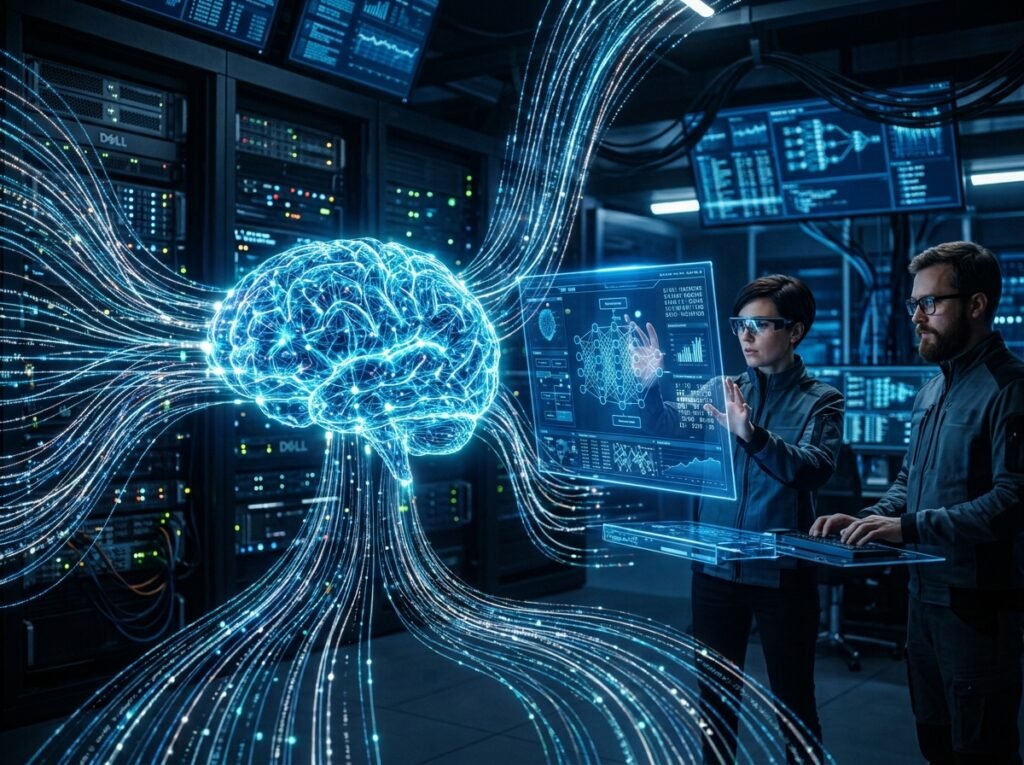
Data Is the Fuel of Machine Learning
Machine Learning depends heavily on data. Without enough high-quality data, even the most advanced algorithms cannot produce reliable results.
Different industries generate enormous amounts of information every day, including customer purchases, medical records, weather observations, financial transactions, website visits, and sensor readings.
This data allows Machine Learning systems to discover valuable insights that would be impossible to identify manually.
Machine Learning Is Everywhere
Many people use Machine Learning every day without realizing it.
- Google predicts your search queries.
- Netflix recommends TV shows.
- YouTube suggests videos.
- Spotify creates personalized playlists.
- Amazon recommends products.
- Banks detect fraudulent transactions.
- Google Photos recognizes faces.
- Navigation apps predict traffic conditions.
- Email services automatically detect spam.
- Online stores recommend products based on browsing history.
These examples demonstrate how Machine Learning has quietly become part of everyday life, improving convenience and helping businesses deliver better services to millions of users worldwide.
Types of Machine Learning
Machine Learning is generally divided into three main categories. Each type is designed to solve different kinds of problems depending on the available data and the desired outcome.
1. Supervised Learning
Supervised Learning is the most widely used type of Machine Learning. In this approach, the algorithm is trained using labeled data, meaning the correct answers are already known.
For example, if we want a computer to recognize cats and dogs, we provide thousands of images that are already labeled as “Cat” or “Dog.” By studying these examples, the algorithm learns the differences between the two animals. Later, when shown a new image, it can predict whether the image contains a cat or a dog.
Common applications include:
- Email spam detection
- Weather forecasting
- House price prediction
- Medical diagnosis
- Credit risk assessment
2. Unsupervised Learning
Unlike supervised learning, unsupervised learning works with unlabeled data. The algorithm receives information without any predefined answers and must discover hidden patterns on its own.
For instance, an online shopping platform may analyze customer purchasing behavior and automatically group similar customers together. Businesses can then use these groups for targeted marketing campaigns.
Common uses include:
- Customer segmentation
- Market research
- Recommendation systems
- Anomaly detection
- Pattern discovery
3. Reinforcement Learning
Reinforcement Learning teaches computers through trial and error. Instead of receiving correct answers, the system learns by interacting with an environment and receiving rewards or penalties based on its actions.
A simple example is teaching a robot to walk. Every successful movement earns a reward, while incorrect actions receive penalties. Over time, the robot discovers the best strategy to achieve its goal.
This approach is commonly used in:
- Self-driving vehicle research
- Game-playing AI
- Industrial robotics
- Resource optimization
- Autonomous decision-making systems
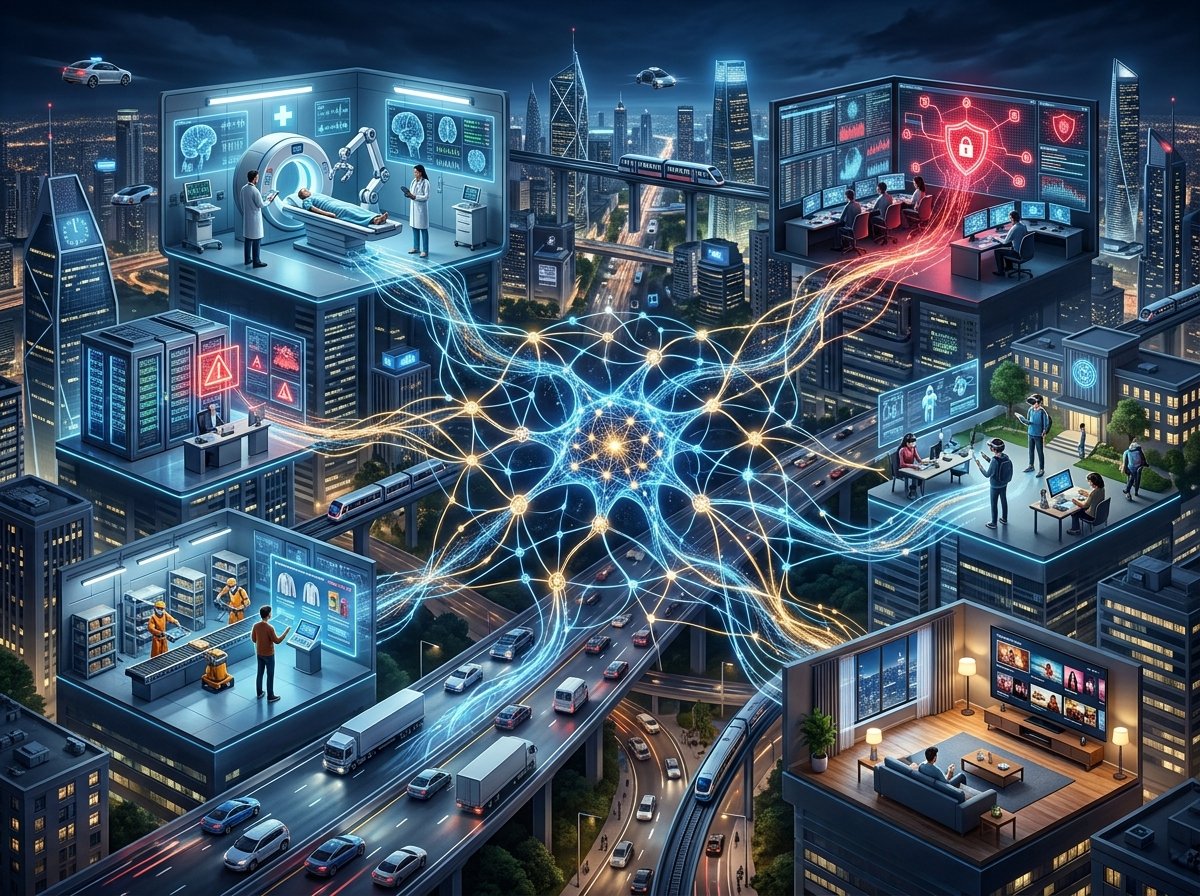
Real-World Applications of Machine Learning
Machine Learning is transforming nearly every major industry by helping organizations make faster and smarter decisions.
Healthcare
Hospitals use Machine Learning to analyze medical images, predict diseases, assist doctors in diagnosis, and recommend personalized treatments.
Banking and Finance
Financial institutions rely on Machine Learning to detect fraudulent transactions, evaluate loan applications, predict market trends, and improve customer security.
E-Commerce
Online shopping platforms recommend products based on customer preferences, browsing history, and previous purchases.
Transportation
Navigation systems estimate travel times, optimize routes, and help researchers develop autonomous vehicles.
Education
Learning platforms use Machine Learning to personalize courses, recommend study materials, and monitor student progress.
Entertainment
Streaming services recommend movies, TV shows, music, and podcasts that match each user’s interests.
Advantages of Machine Learning
Machine Learning provides several significant advantages across industries.
- Processes enormous amounts of data quickly.
- Improves prediction accuracy over time.
- Automates repetitive decision-making.
- Detects hidden patterns humans might overlook.
- Supports better business decisions.
- Reduces operational costs.
- Enhances customer experiences through personalization.
- Continuously improves with additional data.
Challenges of Machine Learning
Despite its remarkable capabilities, Machine Learning also faces important challenges.
- Requires large volumes of quality data.
- Training complex models can be expensive.
- Biased training data may produce unfair results.
- Some models are difficult to explain.
- Privacy concerns arise when handling sensitive information.
- Incorrect predictions can occur if data quality is poor.
Responsible data collection, regular model evaluation, and transparent AI practices help reduce these challenges.
Machine Learning vs Artificial Intelligence
Many beginners confuse Machine Learning with Artificial Intelligence.
Artificial Intelligence is the broader field focused on creating intelligent systems capable of performing tasks that normally require human intelligence.
Machine Learning is one branch of Artificial Intelligence that allows computers to learn from data without being explicitly programmed for every situation.
In simple terms:
- Artificial Intelligence is the complete field.
- Machine Learning is one of the technologies that makes AI possible.
The Future of Machine Learning
Machine Learning continues to evolve rapidly. As computing power increases and more data becomes available, Machine Learning models are becoming faster, more accurate, and capable of solving increasingly complex problems.
Future applications are expected to include smarter healthcare systems, personalized education, improved cybersecurity, climate prediction, scientific research, intelligent manufacturing, and more advanced autonomous systems.
Organizations across the world are investing heavily in Machine Learning because they recognize its potential to transform industries and improve decision-making on an unprecedented scale.
Conclusion
Machine Learning has become one of the driving forces behind modern Artificial Intelligence. By enabling computers to learn from experience instead of relying only on fixed programming, Machine Learning has revolutionized healthcare, finance, education, transportation, entertainment, and countless other industries.
As technology continues to advance, understanding Machine Learning will become increasingly valuable for students, professionals, entrepreneurs, and anyone interested in the future of technology. Rather than replacing human intelligence, Machine Learning is helping people solve problems more efficiently and discover insights that were previously impossible to uncover.
Frequently Asked Questions (FAQs)
What is Machine Learning in simple words?
Machine Learning is a branch of Artificial Intelligence that allows computers to learn from data and improve their performance without being explicitly programmed for every task.
Is Machine Learning part of AI?
Yes. Machine Learning is one of the most important branches of Artificial Intelligence.
What are the three main types of Machine Learning?
The three primary types are Supervised Learning, Unsupervised Learning, and Reinforcement Learning.
Where is Machine Learning used?
Machine Learning is used in healthcare, banking, e-commerce, education, transportation, entertainment, cybersecurity, and many other industries.
Do I need programming to learn Machine Learning?
Basic programming knowledge—especially Python—is highly recommended because it helps you understand algorithms, data processing, and model development more effectively.